
It’s been nine weeks since training started for the Vermont City Marathon and to sum it up as briefly as possible without all the boring details of mileage, splits and what I’m eating for breakfast each day: Things are going frighteningly well. Workouts, sleep, overall health: A+ for all three. OK, maybe B+ for sleep, but that’s as good as it gets for me.
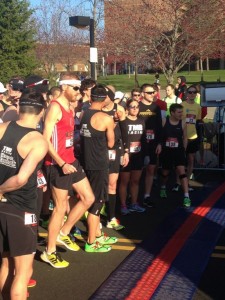
This past Sunday was my first chance to see how all the miles and tough efforts translated to a race setting. My best bud/training partner Josh and I signed up for the Unite Rutgers Half Marathon in New Brunswick, NJ for a couple of reasons:
- It’s 6 weeks out from the marathon which leaves maximum time for recovery and to work on any weak spots.
- It’s a fairly big race (6,000) with a top three finishers historically somewhere in the 1:10-1:12 range.
- The course has a lot of turns, but looks flat.
- It’s free (if you have run 1:11 or faster)
- Finisher’s medal that has a spinny-thing in the middle.
Based on workouts, I toed the line hoping to run somewhere in the 1:12s and finish in the top 3. The night before the race I came up with a simple race plan.
- Go out at 5:30 pace – no faster. Don’t freak out about 5:35. If 5:25s feel possible in the latter half of the race, go with it.
- Run perfect tangents. The course has many turns, some of them very sharp.
- Do what it takes not to end up no-man’s land.
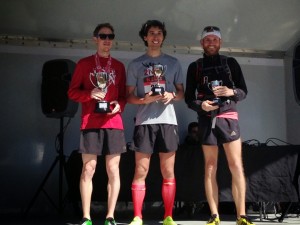 Despite how it might sound, I really enjoyed this race. It was well-organized and well-attended. The parking situation was convenient. There were ample porta-potties. The water stations were well-staffed and evenly-placed. The t-shirts were dri-fit and decent quality. And get this: The awards were early! The trophies were big enough to pour a beer in which is also a plus. The long course appears to have been because of circumstances outside the race director’s control and they responded to my inquiry almost immediately. In a time where road races have been turned into big-corporate money makers where runners pay absurd amounts of money to literally be a faceless number, it’s nice to run a race with 6,000 runners that has all the amenities of a big event but still feels like the people in charge are approachable.I hate when runners complain a course is long or short. When I ran the Runners World Half Marathon in October, I didn't get a perfect 13.1 on my watch either, but it was within what I would call the normal range. In fact, I don’t think I've ever run a race of any distance that measures perfectly on the GPS. That’s a given. But .20-.25 is pretty significant. In the 24 hours after the race it was hard not to think about it. I needed some sort of validation. I emailed the race director who confirmed that Rutgers campus security made them change the course just one hour before the race. They had to move mile 10 at 7:05am. She said it had been hastily re-marked and re-measured, but obviously not re-certified.
The time on the clock may not have said what I had hoped, but I can walk away from this one feeling like I’m still on track. On to Burlington!