
In Greek mythology, Sisyphus offended the gods by trying to cheat death. After he died, as a punishment, the gods condemned him to roll a boulder up a hill for all eternity. Just as he was about to roll the stone over the top, the boulder would roll back to the bottom, and Sisyphus would start all over again. Thousands of years later, the Existentialist writer Albert Camus reimagined the myth. In Sisyphus’s endless toil, Camus saw not punishment, but the possibility of purpose. Sisyphus responds to the absurdity of his punishment not with despair, but with rebellion. He will not bemoan his fate, but will instead embrace it and push himself and the boulder even harder.
All runners can relate to Sisyphus. After all, what could be more absurd than running through heat, cold, wind, snow and rain, running so hard and long that body parts fail and even speech becomes no more than a series of grunts and sighs, all to end up in the same spot where one started? Throw in a hill and, no matter how long or steep, a runner will insist that they will not stop or walk until they reach the top. Why? Ask Sisyphus.
Hills are a way of life here in Vermont, and with all due respect to our beloved Waterfront Bike Path, many of us love running them. Whether it be for the Sisyphean challenge, the view from the top, or the extra bit of fitness they demand, many of us seek out the steepest and longest hills and mountains we can find. Obviously, the longest and most challenging hilly races will be found on the trails, such as the Vermont 100 (miler), part of the “Grand Slam” of the most difficult and competitive 100 milers in the United States (the others being Western States in California, Leadville in Colorado, Old Dominion in Virginia and the Wasatch Front 100 in Utah), but this post will focus on non-ultra events.
Mt. Washington Road Race, Gorham, NH
“It’s just one hill.” The granddaddy of Northeast mountain races, Mt. Washington has been run every year (except 2020, the pandemic year) since 1966. Run entirely on the Mt. Washington Auto Road in late June, this suffer-fest covers 4650 vertical feet in 7.6 miles and includes a 22% grade at its steepest point, which, rather cruelly, is within sight of the finish line 6288 feet above sea level. Only a true New England runner (or a psychopath, but I repeat myself) would have thought of a race this tough, yet so many people vie for the race’s 1000 spots that it selects participants by lottery in late February. In 2026, lottery registration will open on February 9 and close on February 23.
Boston Prep 16 Miler, Derry, NH
This rolling course is considered ideal for anyone planning a spring marathon (Boston in particular, but Vermont City, as well). It is often said that if you can conquer the Boston Prep course in January, you are on pace to conquer the Boston course in April. Much like the Boston Marathon course, there is no one hill that would be intimidating on its own, but the constantly rolling course in Derry, with its biggest hills in the second half (again, much like Boston) will most certainly test your quads.
If you are not ready for the 16 miler or you are not training for a marathon, there is also a 5 miler.
Race to the Top of Vermont, Stowe, VT
Vermont’s answer to the Mt. Washington Road Race, though only “half” as challenging as its distance (4.3 miles), average grade (11%), elevation gain (2564 feet) and summit elevation (3843 feet) are all about half that of Mt. Washington. With a race date on the last weekend of August, it is the perfect way to end the summer. Finishing in under one hour is a real mark of achievement and goal for many, including RunVermont’s Registration Director, Moe Brown, who will look to continue his multi-year streak of finishing in under one hour in 2026!

Moe Brown at the Finish of the 2023 Race to the Top of Vermont
The Race to the Top of Vermont also includes bike and hiking divisions. Something for the whole family!
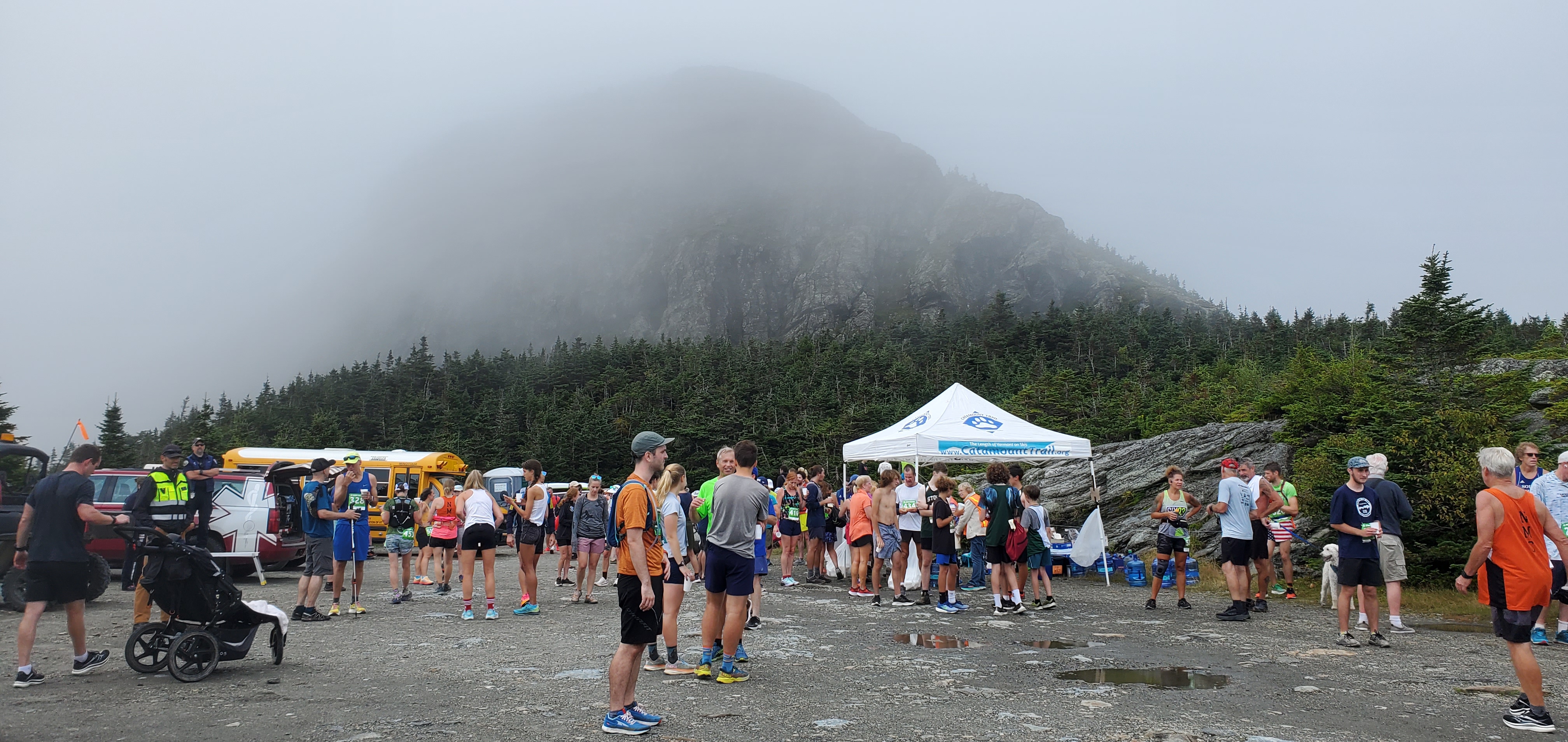
Up in the Clouds at the Race to the Top of Vermont
Seven Sisters Trail Race, Amherst, MA
This 12-mile trail race in early May is widely considered the most challenging trail race in the Northeast. The rocky, technical, singletrack course traverses the ridgecrest of the Holyoke Range and, as such, contains many steep sections with scrambles and bad footing. As one past participant described it, “The ridgeline is like a rollercoaster, but not one of those smooth modern rollercoasters. It's more like an old wooden rollercoaster that keeps you alternating between euphoria and nausea.”
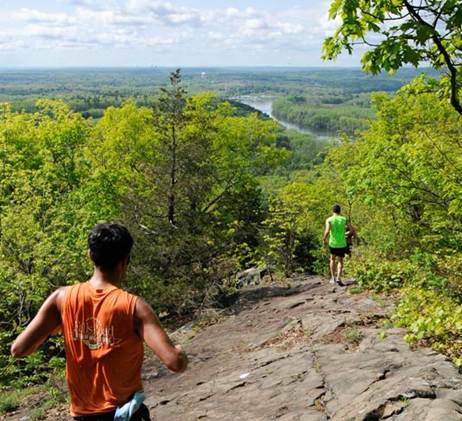
Steep Down at Seven Sisters
USATF-NE Mountain Circuit (various locations around New England)
This series of nine races, with two stops in Vermont, begins in May at Sleepy Hollow and finishes in October in North Conway, NH. Finishing at least six of the nine races will earn you the coveted status of “Mountain Goat.”
Traditionally, “mountain races” were all-uphill (and therefore point-to-point) and entirely off-road, but the genre has evolved to include up-and-down and loop courses, as well as courses that include significant sections on pavement. However, that does not mean they get any easier! Mountain races may be the very toughest challenges for quads, calves and lungs.
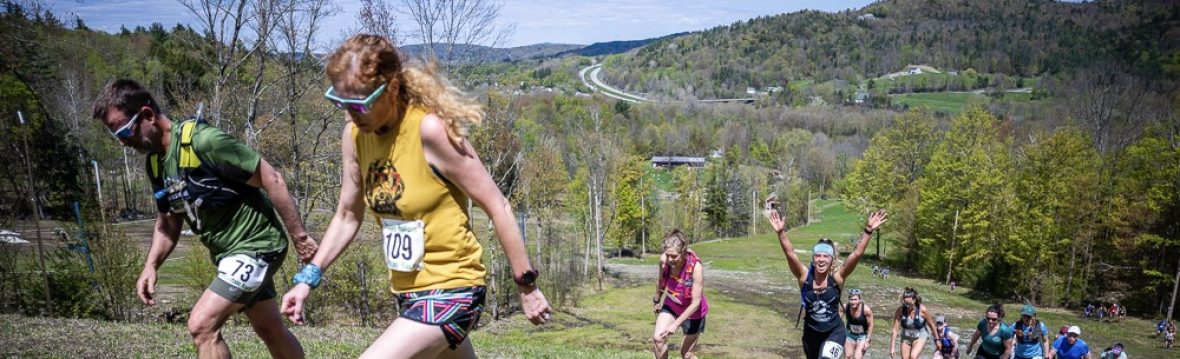
Steep Up at Sleepy Hollow (at Cochran's)